
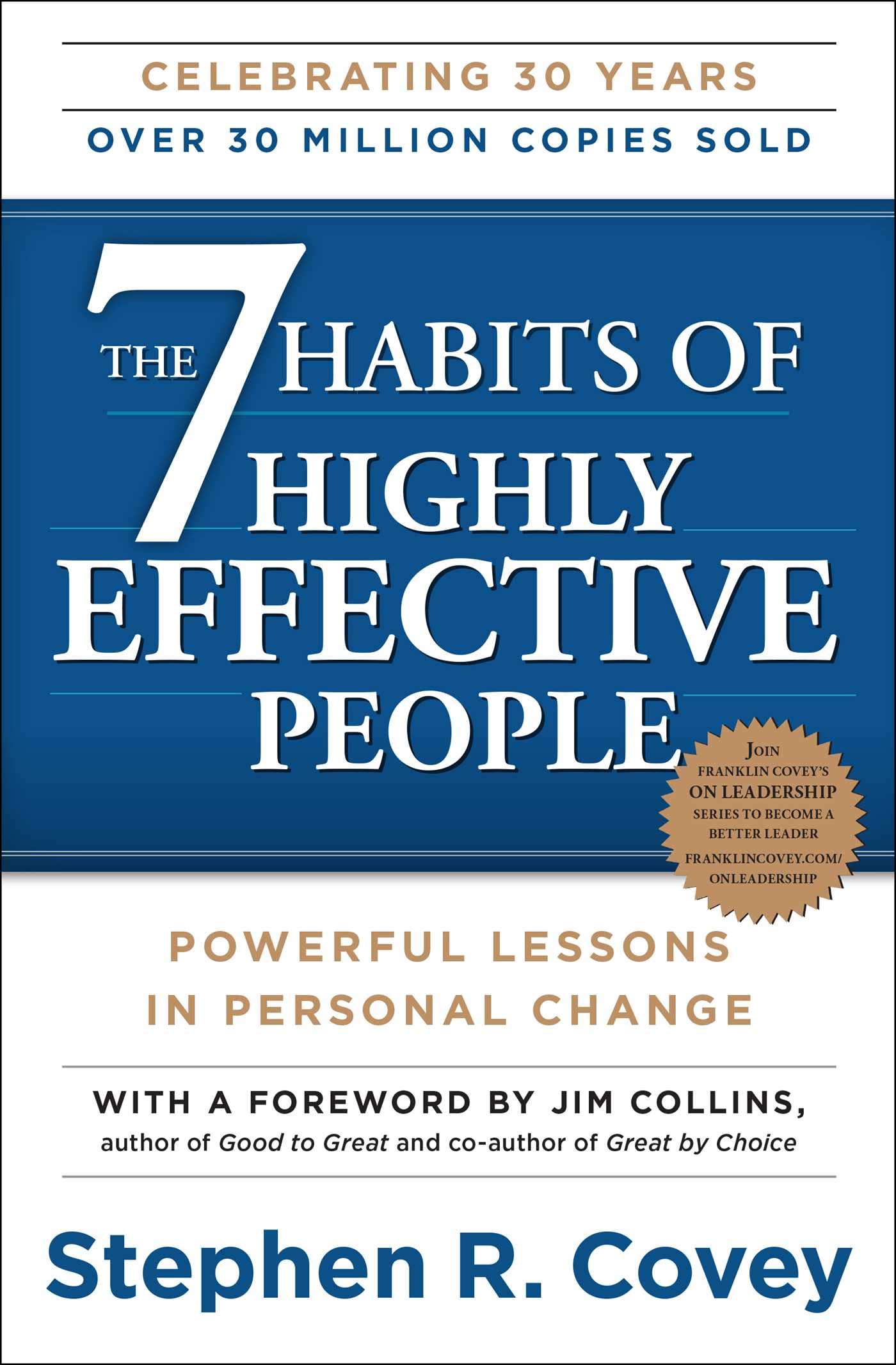
The 7 Habits of Highly Effective People
von Steven Covey
In stark contrast, almost all the literature in the first 150 years or so focused on what could be called the Character Ethic as the foundation of success—things like integrity, humility, fidelity, temperance, courage, justice, patience, industry, simplicity, modesty, and the Golden Rule. Benjamin Franklin’s autobiography is representative of that literature. It is, basically, the story of one man’s effort to integrate certain principles and habits deep within his nature.
The more aware we are of our basic paradigms, maps, or assumptions, and the extent to which we have been influenced by our experience, the more we can take responsibility for those paradigms, examine them, test them against reality, listen to others and be open to their perceptions, thereby getting a larger picture and a far more objective view.
Another principle is human dignity. The basic concept in the United States Declaration of Independence bespeaks this value or principle. “We hold these truths to be self-evident, that all men are created equal, that they are endowed by their Creator with certain unalienable Rights that among these are Life, Liberty, and the pursuit of Happiness.”
It becomes obvious that if we want to make relatively minor changes in our lives, we can perhaps appropriately focus on our attitudes and behaviors. But if we want to make significant, quantum change, we need to work on our basic paradigms.
Another principle is human dignity. The basic concept in the United States Declaration of Independence bespeaks this value or principle. “We hold these truths to be self-evident, that all men are created equal, that they are endowed by their Creator with certain unalienable Rights, that among these are Life, Liberty, and the pursuit of Happiness.”
Another principle is service, or the idea of making a contribution. Another is quality or excellence.
There is the principle of potential, the idea that we are embryonic and can grow and develop and release more and more potential, develop more and more talents. Highly related to potential is the principle of growth—the process of releasing potential and developing talents, with the accompanying need for principles such as patience, nurturance, and encouragement.
Our character, basically, is a composite of our habits. “Sow a thought, reap an action; sow an action, reap a habit; sow a habit, reap a character; sow a character, reap a destiny,” the maxim goes.
Habits, too, have tremendous gravity pull—more than most people realize or would admit. Breaking deeply imbedded habitual tendencies such as procrastination, impatience, criticalness, or selfishness that violate basic principles of human effectiveness involves more than a little willpower and a few minor changes in our lives. “Lift off” takes a tremendous effort, but once we break out of the gravity pull, our freedom takes on a whole new dimension.
I know of no more encouraging fact than the unquestionable ability of man to elevate his life by conscious endeavor.